Practical information
October 9th: Festive gatering at the embassy
Getting there
The event takes place at The Japan Information and Cultural Centre in Brussels.
1 Rue van Maerlant
1040 Brussels
Public transportation
This location is readily accessible by public transportation.
- It is about 20 minutes walking from Brussels Central Station
- It is very close to the smaller train stations of Brussel-Luxemburg and Schuman.
- There are several bus stops nearby, as well as the metro station Schuman.
Travel by car
If you travel by car, be advised that there is no parking space provided by the embassy. It is best to park in one of the many paid parking facilities in the area, like a BePark or Indigo Park facility.
Find the Japanese Embassy on Google Maps
Event schedule
16:30 – Doors open
Please arrive from 16:30 onwards. Upon arrival, there will be a security check at the Embassy before entering the event area.
17:00 – Opening Ceremony & Tea Demonstration
The official opening ceremony will begin at 17:00, followed by a tea demonstration by Kimura sensei.
18:20 – Reception
Following the demonstration, we will move into the reception, giving everyone an opportunity to enjoy some refreshments and meet and exchange with the other guests.
19:45 – End of the event
Please note that all timings may be subject to change.
We kindly ask you to allow enough time for the security check when planning your arrival, so that everyone can be comfortably seated and ready for the beginning of the programme at 17:00.
Dress code
Kimono
For those of you who practice chado, wearing a kimono is preferred.
- Women: we accept all formality levels. When in doubt, iromuji is always a safe choice.
- Men: kimono with hakama is recommended.
There are no facilities to get changed at the venue, so participants in kimono need to arrive already dressed.
Western clothing
For those of you who do not practice chado or choose not to wear kimono, the recommended dress code is smart casual.
Security and luggage
Please remember to bring a valid photo ID with you to the event. You will be required to present it at the entrance of the Embassy in order to gain access to the premises. We kindly ask everyone to make sure they have their ID with them on the day.
If you need to bring luggage with you, there is a possibility to leave it at the Embassy, in another room, during the event. If you would like to make use of this possibility, please let us know in advance so that we can make the necessary arrangements, as storage space at the Embassy is limited we can only store a limited number of suitcases.
All bags and suitcases brought into the Embassy will be subject to a security check upon arrival. Please identify your suitcase with a nametag so we can quickly retrieve it for you at the end.
October 10th and 11th: Kenkyukai intensive study seminar at the Royal Museum of Mariemont
Getting there
The Kenkyukai takes place at the Royal Museum of Mariemont.
Chaussée de Mariemont 100
7140 Morlanwelz
We would like to draw your particular attention to the last part of the journey to the Mariemont Museum. The museum lies at the center of a large park and arboretum. You will therefore have to walk through the park to reach the museum. The museum entrance is marked x on the map below.
The main entrance (marked 1 on the map) is via the tree-lined Drève de Mariemont. There is no public parking inside the estate. Please park on the Drève de Mariemont or on the roadside. This is also the entrance that you will use if you arrive by bus to the bus stop of La Hestre - Les écoles. A tarmac path leads from this entrance up to the museum. It takes about 10 minutes to walk from the entrance to the museum.
There is also an entrance via Rue du Parc at the bottom end of the estate (Sud gate) (marked 2 on the map) . There are two car parks there. An uphill ash track takes you round the estate and up to the museum. Approximately a 20-minute walk.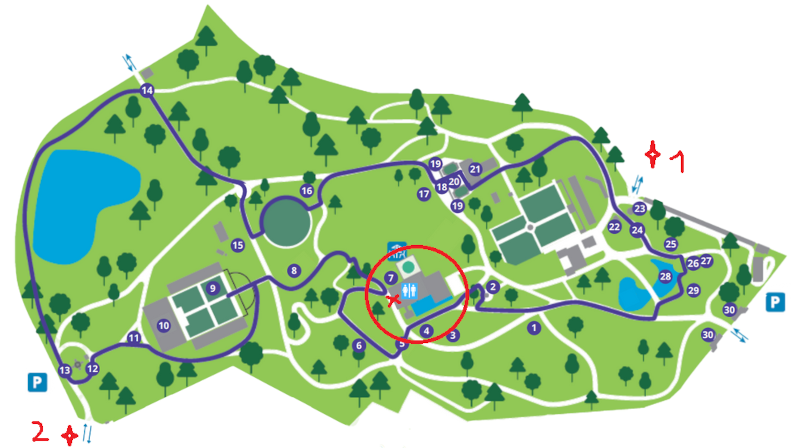
The walking route is not complicated, but depending on the weather, parts of it may be muddy or wet, so we recommend allowing a little extra time and coming prepared in case of rain.
For this reason, we strongly recommend that you arrive wearing normal outdoor shoes rather than your zori. We will provide a bag for your shoes, so that once you arrive you can change into your zori for the Kenkyukai and store your outdoor shoes in the vestiaire along with your coat.
Please make sure you allow enough time for the walk through the park when planning your arrival.
Public transportation
From Brussels
- Take an NMBS/SNCB train from Brussels-Midi, Brussels-Central, or Brussels-North to La Louvière-Centre (or La Louvière-Sud, depending on the connection).
- From La Louvière-Centre, take TEC bus 82 and get off at La Hestre – Écoles.
- Alternatively, from La Louvière-Sud, take TEC bus 30 to the same stop.
- From La Hestre – Écoles, the museum is approximately a 10-minute walk through the Mariemont estate.
- Exit the station and take TEC bus 82 towards Trazegnies/Morlanwelz.
- Get off at La Hestre – Écoles.
- Walk for about 10 minutes to reach the museum entrance.
From La Louvière-Centre Station
- Exit the station and take TEC bus 82 towards Trazegnies/Morlanwelz.
- Get off at La Hestre – Écoles.
- Walk for about 10 minutes to reach the museum entrance.
Travel tip
Use the NMBS/SNCB journey planner for train schedules and the TEC app or website for local bus times, as connections may vary throughout the day.
Taxi
If you would like to share a taxi with other participants, please let us know. We will do our best to put you in touch with others travelling on a similar schedule so that you can arrange shared transportation together.
Carpool
We also expect to have a small number of volunteers available to offer rides to and from the museum. As the number of seats is very limited, priority will be given to participants attending the kenkyūkai in kimono, as this makes travelling by public transport more challenging.
Travel by car
The museum does not have parking space available. You can park your car along the edge of the road on Drève de Mariemont.
Schedule
The doors will open at 10:00 sharp on both days.
We will have 15 minutes for everyone to arrive and register. During this time, we will welcome you, give you any necessary information and directions, take your coats, and help with any other practical arrangements.
We have our own reception area in the main hall of the museum. This means turn to the left as you enter the museum. Do not go to the general museum reception area to the right of you.
On Day 2, if you need to leave your luggage at the museum during the Kenkyoukai, please let us know in advance so that we can be prepared to receive it.
Please note that registration will close 15 minutes after the doors open. If you arrive after this time for any reason, you will still be able to join the event, but you will need to be accompanied to the auditorium by a member of the museum staff. This means that if you arrive late on Day 1, you will unfortunately miss the tea demonstration by Kimura sensei. We therefore kindly ask everyone to be sure to arrive on time.
Likewise the museum doors close at 17:00 sharp every day. This means that everyone has to be outside at 17:00 at the latest. The park around the museum is open until 18:00.
Day one - Saturday 10th of October
10:00 - Arrival & registration
10:15 - Opening ceremony at pavilion
10:30 - Demonstration by Kimura sensei
11:00 - Go to the auditorium
11:10 - Okeiko
13:00 - Lunch + tatedashi
14:00 - Okeiko konarai
16:30 - Closing words day1
16:40 - Exit the museum
17:00 - Museum doors close
18:00 - Museum park closes
Day two - Sunday 11th of October
10:00 - Arrival & registration
10:15 - Okeiko shikaden
13:00 - Lunch + tatedashi
14:00 - Okeiko okuden
16:30 - Okeiko end - closing ceremony
16:40 - Exit the museum
17:00 - Museum doors close
18:00 - Museum park closes
Please note that all timings may be subject to change.
We recommend that all participants allow some flexibility in their planning and arrive with sufficient time before the start of the programme.
Dress code
Day 1
People participating in temae either as host or guest: kimono required.
People in the audience: kimono preferred.
Day 2
Kimono required for everyone present.
Type of kimono
For women iromuji kimono with fukuro obi is recommended. If you do not have an iromuji kimono, other types of kimono are acceptable.
For men kimono with hakama is required. This means that you are kindly asked to not wear jitoku, even if you have chamei.
Practicalities
There are no facilities to get changed at the venue. Participants in kimono need to arrive already dressed.
We recommend that you wear western shoes to walk through the park as the paths can be a bit dirty and change into tabi and zori inside the museum. We will provide plastic bags to store your shoes securely along with your coat check.
We also recommend to bring your fukusabasami or sukiyabukuro, even if you are not assigned a role on tatami. Your fukusa will be required for the warigeiko segment on day 1 and you will also need your sensu and possibly kaishi.
Photography, Video and Notes
We would like to remind everyone that no photographs, videos or notes may be taken during okeiko at the Kenkyukai.
Please take a moment to read our Media Policy before the event, as it contains the full guidelines regarding photography, filming, recording and sharing of content.
We have appointed a few designated photographers that will take photographs during the moments before and after okeiko. We will share these images with you after the event.
There will take a group photograph taken on Saturday.
Demonstration at the chashitsu
During the demonstration by Kimura sensei in the chashitsu, there will be chairs available for about 20 Urasenke people, which is about half of our group. We would like the chairs to be available for those of us who need them. Please consider carefully if you need a chair or if you would be able to stand up for the duration of the demonstration, which will be about 30 minutes.
The demonstration will also be attended by about 10 guests who do not belong to Urasenke and who will not participate in the rest of the Kenkyukai. These guests will be served tea during the demonstration. Everyone else will have a chance to drink tea during lunch.
Tea during lunch
We have planned a tatedashi moment during lunch. Since not everyone will have the oportunity to drink tea during okeiko, we want to give all of you the chance to have tea during lunch. A tatedashi corner will be set up for you to whisk tea for yourself or one of your friends. Please try to spread this out over the entirety of the lunch break, so as not to overwhelm the tatedashi station towards the end of lunch. We also kindly ask that you wash your own bowl once your are done. Tatedashi will end 10 minutes before afternoon okeiko resumes.
Temae schedule
Kimura sensei and the Belgian instructors have made a temae schedule for okeiko. Please note that this schedule is subject to change, depending on how the teaching goes. Especially the last temae of each half day is not guaranteed to take place.
DAY 1
Morning
Warigeiko
Usucha Hirademae
Tsuzuki usucha (time allowing)
Afternoon - Konarai
Tsutsumibukusa
Chawan kazari
Kinin date koicha
Usucha tana so kazari (time allowing)
DAY 2
Morning - Shikaden
Daitemmoku
Bondate
Wakin (time allowing)
Afternoon - Okuden
Gyo no gyo
Daien no so
FAQ about Museum of Mariemont
Wifi
The museum building has solid concrete walls. This means phone and mobile internet signals have difficulty reaching inside. We therefore recommend connecting to the museum wifi.
Wifi: CFWB_Guest
Password: WIFI-GUEST@CFWB
Toilet
The toilets are located on -1 below the stairs
Elevator
Please use the stairs as much as possible when moving to different locations within the museum, provided that your physical condition allows it. The elevator is slow and we want to reserve it for those of us who need it.
Visiting the museum
If you find a free moment during the Kenkyukai, you are allowed to visit the museum. The museum opening times are from 10:00h till 17:00h. Your Kenkyukai name badge will serve as admission for the permanent exhibitions. If there is a special exhibition, it requires a supplementary entrance free. Please do not enter the chashitsu in the museum under any circumstance.
Eating and drinking
Eating and drinking is not allowed in the museum, with the following expections:
- we are allowed to eat our lunch in the hall
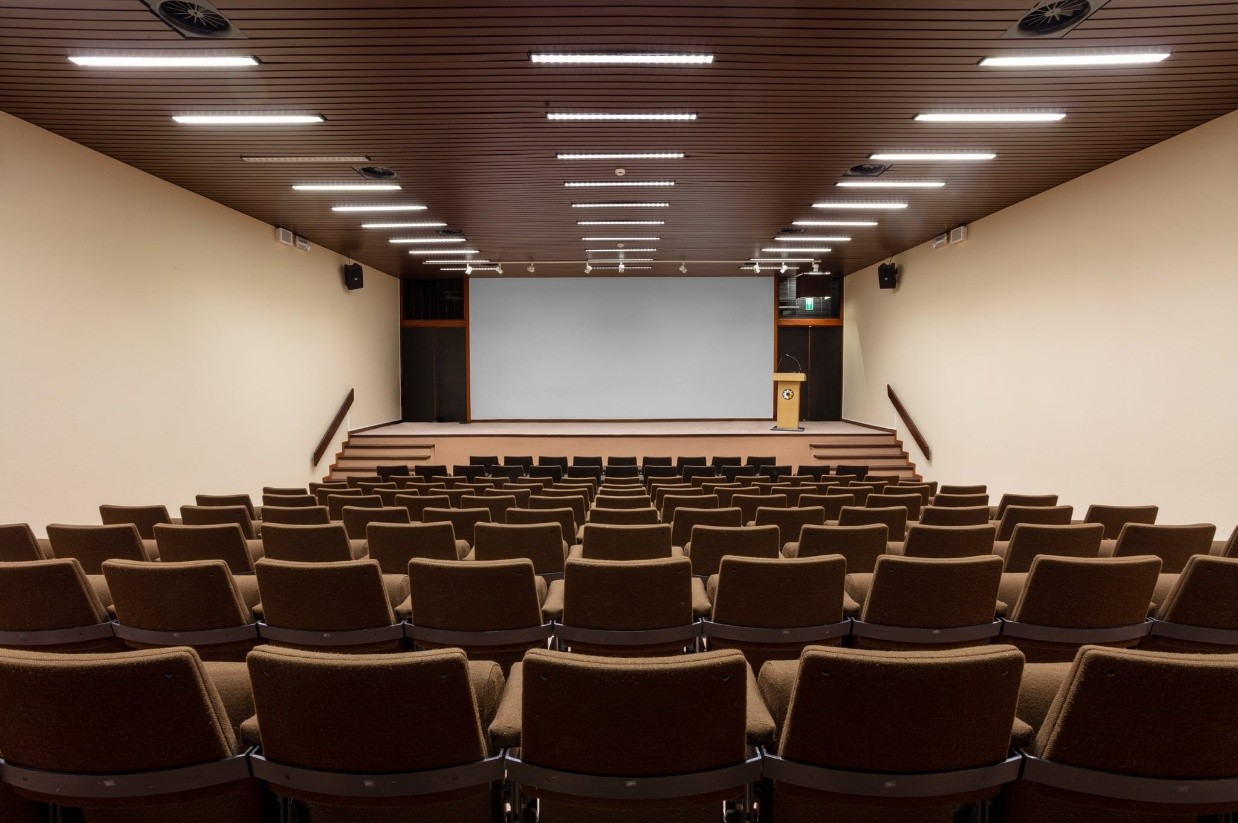
- we are allowed to drink in the auditorium
Okeiko flow
We have organized the workflow for okeiko in a way that will minimize transition time between temae. There will be slight differences compared to what you are used to at the Belgian seminars.
On the tatami
Greeting sensei
People studying on the tatami will collectively do one aisatsu (bow all together) to Kimura sensei at the start of the temae and one at the end of temae. Teishu will sit in the fumikomidatami to do this (as usual). Guests will do this from their guest position.
Seiza
If you can, please try to sit without seiza aide on the tatami. If you have difficulty sitting as a guest during the temae, a small invisible seiza aide will be allowed. Please refrain from using a seiza aide as teishu.
Koicha temae
To start a koicha temae, the procedure will be as follows:
- guests are seated
- teishu brings the sweets to the guests
- guests start to eat the sweets immediately
- meanwhile teishu brings the mizusashi and the chaire
- then everyone on the mat bows to Kimura sensei to request teaching for the start of the temae
Guests
Guests wait to get up until the entire temae, including haiken and final aisatsu, is finished. It is only after the final aisatsu that the guests of the next temae will take their place on the tatami.
In the mizuya
Each temae will already have been set up as much as possible beforehand by the mizuyateam to save time.
Teishu
The next teishu may enter the mizuya to start preparing the final details of their temae at the moment when the previous teishu leaves with the kensui (at the start of haiken).
At the start of temae, teishu will carry each object straight from the mizuya to temaeza. They are not placed on the tatami next to the yojohan mats as we tend to do in the seminars.
Cleaning up
At the end of the temae, teishu cleans up their own temae. Keep the cleanup fast, quiet and minimal.
- Rinse and dry the kensui.
- Wash and dry the bowl.
- Quickly rinse chasen and chakin in the dirty chakindarai. Do not clean them thoroughly as that will take too much time and will be done by the mizuyateam afterwards.
- Do not empty the natsume/chaire.
- Do not start clean up during the guests’ haiken time but wait until the temae is finished.
Be mindful of the difference between zokin (impure, grey) and fukin (clean, blue) towels.
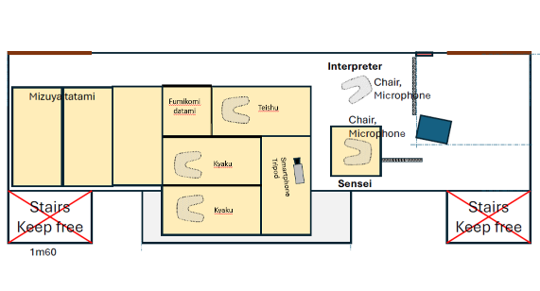
Auditorium schematic
Below you see a diagram of how the practice space on the auditorium stage will be organized.
We are looking forward to seeing you all very soon and to sharing these two special days together!

 English
 Français
 Nederlands